
Why Dubai Needs a New Generation of Stormwater Infrastructure
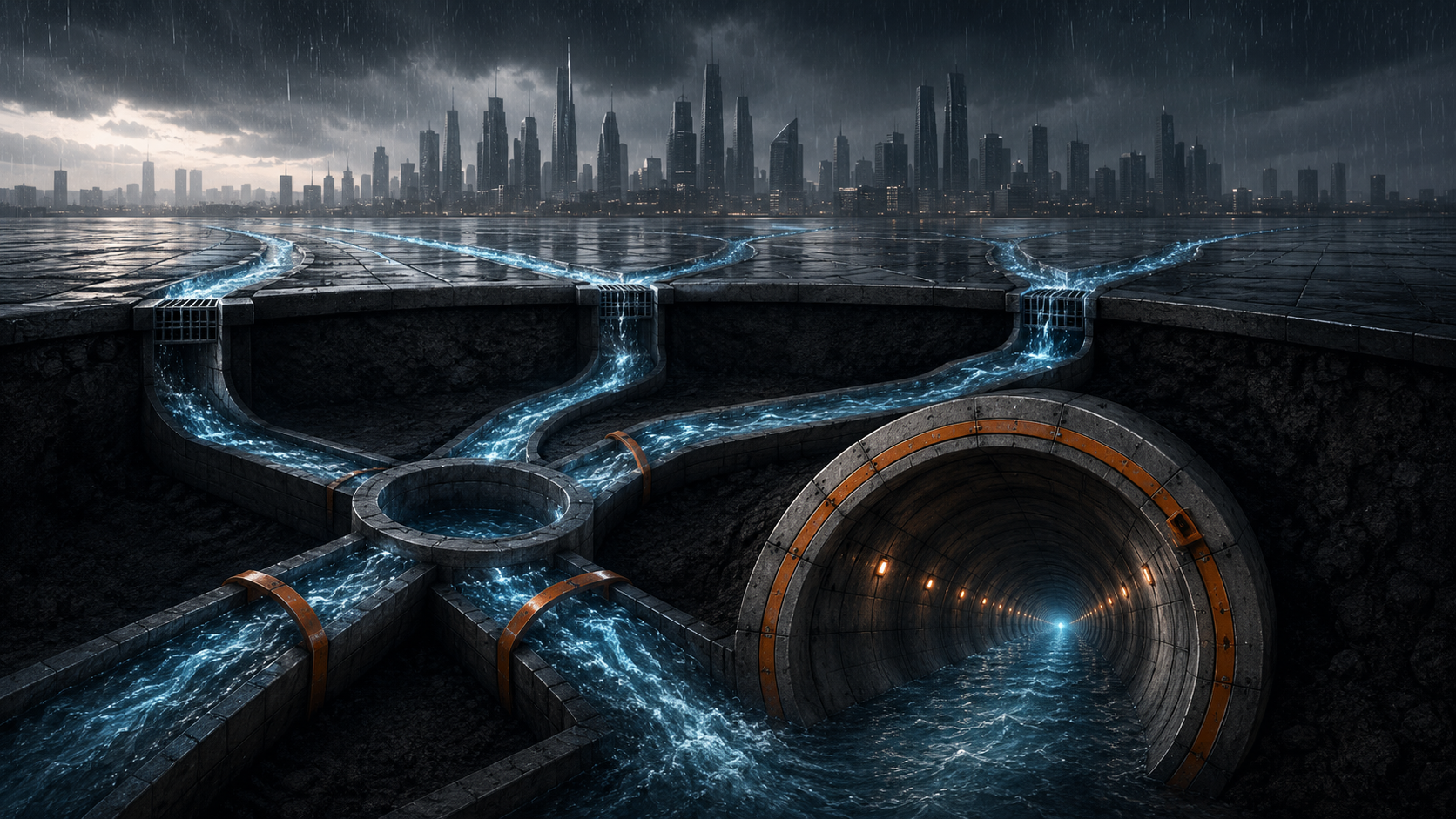
Dubai does not need new stormwater infrastructure simply because it receives rain. It needs it because the city itself has changed.
Dubai is investing heavily in a new generation of stormwater infrastructure. The most important question is not what projects Dubai is building, but why such a major expansion is necessary.
The answer is not simply that Dubai is receiving more rain. Rapid urban growth, increasing population, expanding developed areas, more impermeable surfaces, extreme-rainfall risk and the need to protect critical infrastructure are changing the hydraulic requirements of the city.
1. Dubai is no longer the same city its older infrastructure was designed for
Between 1960 and 2020, Dubai's population increased from approximately 40,000 to 3.3 million, while its urban and built-up area increased approximately 170 times. Dubai's population is expected to reach around 5.8 million by 2040, with the daytime population potentially reaching 7.8 million.
A growing city means more buildings, roads, parking areas, paved surfaces, industrial developments, airports, logistics facilities and urban infrastructure. Natural ground allows part of the rainfall to infiltrate into the soil. Roads, rooftops and other impermeable surfaces reduce infiltration and increase surface runoff.
More urban development means more water reaching the drainage network.
Sources: Government of Dubai Media Office - Dubai 2040 Urban Master Plan (2021); U.S. Environmental Protection Agency - Urbanization and Stormwater Runoff (2026).
2. The main problem is not annual rainfall - it is rainfall intensity
Drainage infrastructure is not designed only according to average annual rainfall. One of the most important design considerations is how much rain can fall within a short period and how quickly that water reaches the drainage system.
The UAE experienced an exceptional rainfall event on 16 April 2024. The National Centre of Meteorology confirmed that it was the heaviest rainfall event recorded in the country since systematic climate records began in 1949. At Khatm Al Shakla in Al Ain, 254 mm of rainfall was recorded in less than 24 hours.
To be technically precise, 254 mm was not the recorded rainfall amount for Dubai. It was the highest reported measurement from that UAE-wide event, recorded in Al Ain. For Dubai, the event demonstrated the potential consequences of extreme rainfall across highly developed urban areas.
Source: National Centre of Meteorology / Emirates News Agency - WAM (2024).
3. Urbanisation changes rainfall into faster runoff
The basic hydrological relationship can be simplified as:
Rainfall = Infiltration + Storage + Evaporation + Runoff
Urbanisation changes this balance. As impermeable areas increase, infiltration decreases, surface runoff increases, water reaches the drainage system faster and peak flow rises.
Two catchments receiving the same rainfall may therefore respond very differently. A largely undeveloped catchment can absorb and temporarily store part of the rainfall. A heavily urbanised catchment transfers a much larger proportion rapidly into the stormwater system.
Source: U.S. Environmental Protection Agency - Urbanization: Stormwater Runoff and Hydrology (2026).
4. Peak flow can become more important than total rainfall volume
Urban stormwater infrastructure must deal not only with the total volume of water but also with the rate at which it arrives. Impervious surfaces allow runoff to move more quickly, producing larger and more rapid stormwater flows and higher peak discharges.
Consider two simplified events: 100 mm of rain over 24 hours and 100 mm concentrated into only a few hours. The total rainfall is identical, but the second event can create a much higher peak flow and much greater pressure on pipes, tunnels, pumping stations and discharge facilities.
Source: U.S. Environmental Protection Agency (2026).
5. Future development will create additional drainage demand
The Dubai 2040 Urban Master Plan expects the resident population to grow from 3.3 million in 2020 to approximately 5.8 million by 2040. Future drainage design must therefore consider future development, population, land use, impermeable area and hydraulic loading - not only today's catchment.
A system that is adequate today may not provide the same performance after another twenty or thirty years of urban development.
Source: Government of Dubai Media Office - Dubai 2040 Urban Master Plan (2021).
6. Local systems must operate as part of a larger network
As cities grow, solving stormwater problems only at individual locations becomes increasingly difficult. Dubai Municipality has stated that its objective includes connecting areas of the emirate through a unified network of deep tunnels.
The wider system can be understood as a connected chain: catchment and local collection, main trunk pipelines and strategic tunnels, followed by storage, pumping and controlled discharge. Dubai is not simply installing larger pipes; it is developing a more integrated hydraulic system.
Source: Dubai Municipality / Government of Dubai Media Office (2025).
7. Dubai must prepare for future climate-related challenges
When the Tasreef programme was approved, the Government of Dubai stated that the new infrastructure is intended to strengthen the emirate's readiness for future climate-related challenges, including the potential impact of increased rainfall.
This does not mean every future event can be predicted precisely. It means infrastructure needs sufficient capacity, resilience, flexibility and redundancy to handle a wider range of possible conditions.
Source: Government of Dubai Media Office - Tasreef announcement (2024).
8. The consequences of flooding are much greater in today's Dubai
Stormwater drainage is no longer simply a municipal issue. A major rainfall event can affect roads, public transport, airports, logistics, businesses, residential communities and utilities. A drainage problem can become a transport problem, a logistics problem and eventually an economic problem.
The value of drainage infrastructure should therefore be measured not only by how much water it removes, but also by how well it protects the operation of the city.
Source: Dubai Municipality / Government of Dubai Media Office (2026).
9. The required level of reliability has increased
As a city develops, its tolerance for infrastructure disruption becomes lower. Drainage infrastructure must increasingly be considered part of the city's critical resilience system.
No practical stormwater system can remove every possible level of risk. The objective is to reduce the probability of failure, reduce the consequences of extreme events and allow the city to recover more quickly.
Engineering interpretation based on the resilience objectives stated in Dubai Municipality and Government of Dubai infrastructure announcements.
10. The 700% capacity increase shows the scale of change
Dubai's Tasreef programme is designed to increase the emirate's rainwater drainage capacity by approximately 700%. The programme has an estimated value of AED 30 billion, is planned for phased completion by 2033 and is intended to provide drainage infrastructure for approximately the next 100 years.
The planned system is intended to handle more than 20 million cubic metres of water per day, while the announced tunnel flow capacity is approximately 230 cubic metres per second. This is not simply a replacement of old pipelines; it is a major change in the scale at which Dubai intends to manage stormwater.
Source: Government of Dubai Media Office - Tasreef (2024).
The engineering equation
Urban growth + increasing impermeable area
→ Higher runoff + higher peak flow
→ Extreme rainfall risk + critical infrastructure exposure
→ Need for greater stormwater capacity and resilience
What comes next?
Large trunk pipelines, deep tunnels, strategic storage, pumping stations, TBMs, microtunnelling and pipe jacking are not the starting point of the story. They are engineering responses to the hydraulic problem.
Dubai has officially announced that its new stormwater strategy will include major tunnel infrastructure and advanced Tunnel Boring Machines as part of the drainage network.
Conclusion
Dubai's stormwater challenge is not simply a rainfall problem. It is a combination of rapid urban growth, changing catchment behaviour, increasing runoff, higher peak hydraulic loads, extreme-event risk, future climate uncertainty and the need to protect increasingly valuable and interconnected infrastructure.
The infrastructure is changing because Dubai is changing.
References
- Government of Dubai Media Office (2021) - Dubai 2040 Urban Master Plan
- Government of Dubai Media Office (2024) - AED 30 billion Tasreef project
- Dubai Municipality / Government of Dubai Media Office (2025)
- Dubai Municipality / Government of Dubai Media Office (2026)
- National Centre of Meteorology / Emirates News Agency - WAM (2024)
- U.S. Environmental Protection Agency - Urbanization and Stormwater Runoff (2026)
Oğuzhan Ataşalar
Microtunnelling & NDRC Project Manager · Dubai